

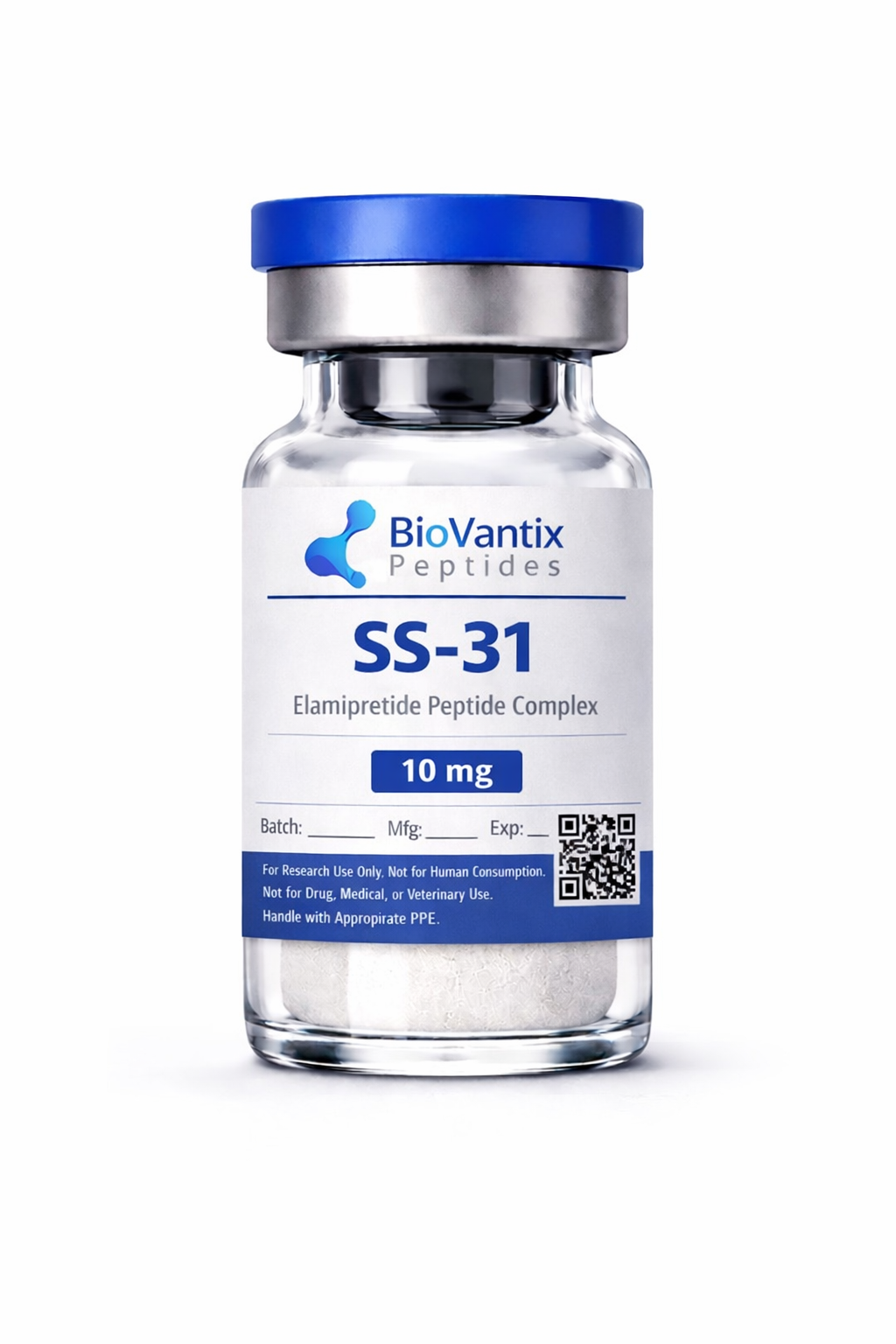
SS31 10mg
SS-31 is a synthetic mitochondria-targeting tetrapeptide studied for its interaction with cardiolipin, a phospholipid concentrated in the inner mitochondrial membrane. In experimental systems, SS-31 has been investigated for its effects on mitochondrial membrane architecture, electron transport efficiency, ATP-associated bioenergetics, and redox balance. It is widely used in biochemistry and cell biology research focused on mitochondrial function, peptide–membrane interactions, and mechanisms related to oxidative stress and cellular energetics.
References:
Chavez JD et al., Elife, 2020
Mitchell W et al., J Biol Chem, 2020
Tung C et al., J Transl Genet Genom, 2025
$85.00 Original price was: $85.00.$60.00Current price is: $60.00.
All Peptides
Popular Peptides
Peptide Capsules
Peptide Blends
IGF-1 Proteins
Bioregulators
Cosmetic Peptides
Melanotan Peptides
SS31 Overview
SS-31, also known as elamipretide, is a synthetic mitochondria-targeting tetrapeptide studied in preclinical and translational research as a regulator of mitochondrial bioenergetics, membrane organization, and stress-response signaling. The peptide is designed to localize to the inner mitochondrial membrane, where it associates with cardiolipin, a phospholipid central to cristae structure and electron transport chain function. Experimental literature has evaluated SS-31 in diverse in vitro systems, ex vivo preparations, and in vivo animal models as a tool for probing pathways linked to mitochondrial respiration, reactive oxygen species handling, ATP production, membrane potential stability, and injury-responsive cellular programs.
SS31: Biochemical Characteristics
SS-31: Biochemical Characteristics
Amino Acid Sequence: D-Arg-Dmt-Lys-Phe-NH2
Molecular Formula: C32H49N9O5
Molecular Weight: 639.8 g/mol
PubChem CID: 11764719
CAS Number: 736992-21-5
Synonyms: elamipretide, Bendavia, MTP-131, SS-31
SS-31 belongs to the Szeto-Schiller class of aromatic-cationic tetrapeptides. Its structure combines basic and aromatic residues in a way that promotes mitochondrial accumulation and interaction with cardiolipin-rich membrane environments. Rather than functioning as a classical receptor ligand, SS-31 is studied for how its membrane-level interactions may stabilize inner mitochondrial membrane architecture, support respiratory supercomplex organization, and modulate stress-linked mitochondrial signaling under defined experimental conditions.
SS31: Research Applications
SS-31 is used as a research peptide in mechanistic studies of mitochondrial dysfunction and bioenergetic stress. Typical preclinical applications include cell-based assays examining mitochondrial membrane potential, oxygen-consumption rate, ATP generation, proton leak, and oxidative stress readouts such as ROS formation and redox-sensitive signaling. It is also used in models of ischemia-reperfusion injury, age-related energetic decline, inflammatory stress, and mitochondrial myopathies to investigate how cardiolipin-targeted peptide interactions influence cellular resilience and metabolic recovery.
In vivo animal studies and ex vivo tissue models employ SS-31 to investigate endpoints such as mitochondrial respiration, muscle performance, cardiac function, renal injury response, and neuronal survival under controlled experimental conditions. In translational literature, elamipretide has also advanced into clinical development, and Stealth BioTherapeutics reports that it received FDA accelerated approval on September 19, 2025 as FORZINITY for Barth syndrome in eligible patients, reflecting the compound’s movement beyond purely exploratory research settings.
SS31: Pathway / Mechanistic Context
Mechanistically, SS-31 is studied as a cardiolipin-binding mitochondrial peptide that concentrates at the inner mitochondrial membrane and influences bioenergetic function. Preclinical literature describes associations with improved electron transport chain efficiency, reduced pathogenic ROS formation, improved ATP production, and decreased proton leak. These effects are often discussed in the context of preserving cristae architecture and supporting interactions among oxidative phosphorylation components.
Additional mechanistic work suggests that SS-31 may interact not only with cardiolipin itself but also with cardiolipin-associated mitochondrial proteins involved in ATP production and 2-oxoglutarate metabolism. Cross-linking and mass spectrometry studies identified SS-31-associated mitochondrial protein networks consistent with roles in oxidative phosphorylation and metabolic regulation, supporting the view that the peptide acts at the level of membrane-protein organization rather than through a single canonical signaling receptor.
In oxidative injury and aging-related models, laboratory studies have examined whether SS-31 can shift redox balance, improve mitochondrial coupling, and attenuate stress-linked loss of energetic capacity. Such work is framed as mechanistic investigation into mitochondrial quality control, membrane stabilization, and bioenergetic recovery in controlled systems.
SS31: Preclinical Research Summary
Preclinical studies of SS-31 include in vitro experiments across cardiomyocyte, myocyte, neuronal, renal, and other mitochondria-relevant cell systems, as well as in vivo animal studies in which mitochondrial and tissue-function endpoints are quantified. Reported findings commonly include improved mitochondrial respiration, reduced ROS burden, increased ATP-linked flux, reduced membrane instability, and attenuation of injury-associated functional decline in models of cardiac stress, renal stress, neurodegeneration, and aging-related bioenergetic impairment.
Additional literature describes SS-31-associated changes in mitochondrial ultrastructure, exercise tolerance in aged mice, and improved energetic parameters in experimental models where mitochondrial dysfunction is a central variable. More recent mechanistic work has also explored effects that appear independent of major cardiolipin remodeling, suggesting that functional stabilization of mitochondrial protein interactions may contribute to observed outcomes.
All summaries above refer to controlled research or translational literature and are provided to support experimental design considerations, mechanistic hypothesis generation, and pathway mapping in laboratory and scientific contexts.
SS31: Form & Analytical Testing
SS-31 is supplied as a research-grade synthetic peptide. Identity and composition are commonly assessed using analytical methods such as HPLC for purity profiling and mass spectrometry for molecular confirmation. Additional characterization may include peptide content, residual solvent testing, water content, and salt-form verification where applicable. In mitochondrial assay development, researchers also evaluate solution conditions carefully, as buffer composition, pH, and membrane model selection can influence peptide-membrane interaction behavior in vitro.
Researchers should handle SS-31 using standard laboratory practices appropriate for synthetic peptides, including attention to storage conditions, solvent compatibility, adsorption losses at low concentration, and assay-specific controls for mitochondrial readouts and membrane-dependent effects.
Referenced Citations
[1] Szeto HH, Schiller PW. Novel therapies targeting inner mitochondrial membrane—from discovery to clinical development.
https://pubmed.ncbi.nlm.nih.gov/19524571/[2] Szeto HH. First-in-class cardiolipin-protective compound as a therapeutic agent to restore mitochondrial bioenergetics.
https://pubmed.ncbi.nlm.nih.gov/22264568/[3] Szeto HH, Liu S, Soong Y, Wu D, Darrah SF, Cheng FY, Zhao Z, Ganger M, Tow CY, Seshan SV. Mitochondria-targeted peptide SS-31 improves mitochondrial function and reduces oxidative stress.
https://pubmed.ncbi.nlm.nih.gov/19917606/[4] Birk AV, Chao WM, Bracken C, Warren JD, Szeto HH. Targeting mitochondrial cardiolipin and the cytochrome c / cardiolipin complex to promote electron transport and optimize mitochondrial ATP synthesis.
https://pubmed.ncbi.nlm.nih.gov/21521673/[5] Zhao K, Zhao GM, Wu D, Soong Y, Birk AV, Schiller PW, Szeto HH. Cell-permeable peptide antioxidants targeted to inner mitochondrial membrane inhibit mitochondrial swelling and cell death.
https://pubmed.ncbi.nlm.nih.gov/15710646/[6] Stealth BioTherapeutics. Elamipretide (SS-31) – Mitochondria-targeting peptide research and development overview.
https://stealthbt.com/science-pipeline/
RUO Disclaimer
For Research Use Only (RUO). Not for human consumption.